Night Market Sales Depend on Commercial Readiness, Not Just a Single Menu Item
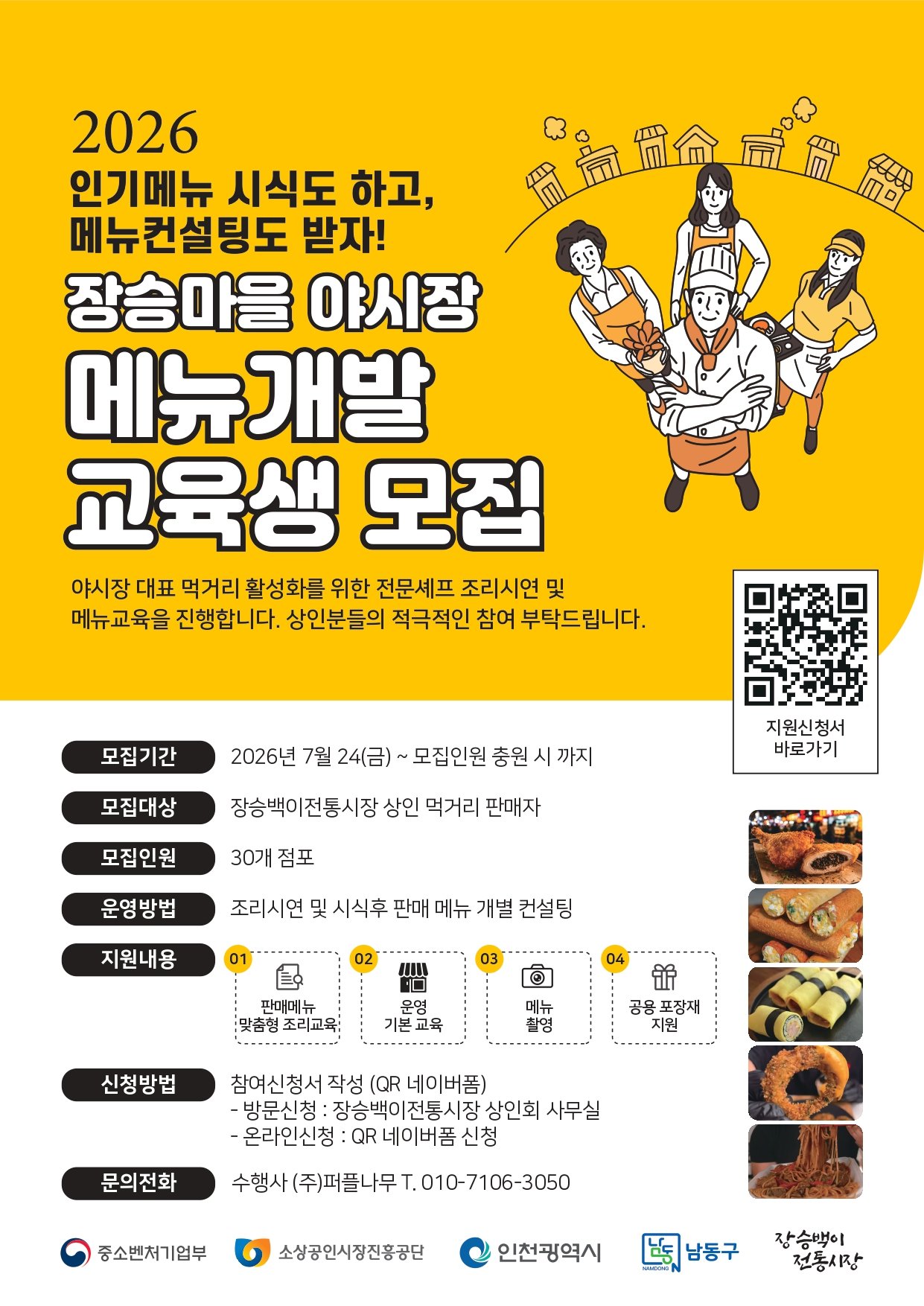
Jangseungbaegi Traditional Market in Namdong-gu, Incheon, is recruiting participants for the “2026 Jangseung Village Night Market Menu Development Training” to cultivate signature night market foods. The program is open to 30 food vendors operating within the market. It is a hands-on initiative connecting professional chef-led cooking instruction with vendor-specific menu consulting, photography, and packaging support.
At a night market, good taste alone does not immediately make a menu competitive. Food must be served quickly after ordering, be convenient to eat while walking, and communicate its distinctive qualities through both photography and packaging. A menu developed without considering food costs and kitchen workflow may be difficult to sell consistently, even if visitors respond positively. This program is worth considering because it offers an opportunity to assess these issues at the individual vendor level.
Evaluate the Support from an Operational Perspective
According to the recruitment information provided, participants will learn about restaurant menu preparation and commercialization through cooking demonstrations and tastings led by professional chefs. Each vendor will then receive individual consulting to improve an existing menu item or develop a new signature offering.
- Cooking demonstrations and tastings led by professional chefs
- Cooking instruction tailored to each vendor’s menu
- Menu assessment and improvement consulting for each vendor
- Basic training required for night market operations
- Food photography support for items being sold
- Shared packaging material support
Small restaurant and food-service business owners should focus less on the number of training components and more on whether the recommendations can be applied in their actual operations. Key questions include whether the menu can be prepared using existing kitchen equipment, whether production can meet peak-hour demand, and whether ingredient storage and waste burdens are manageable. Photography and packaging support will also be more effective after the menu name, price, and serving format have been finalized.
Prepare in the Following Order After Applying
1. Quantify the Current Menu’s Problems
First, record the selling price of the signature item, the amount of ingredients used per serving, preparation time, and the number of servings prepared each day. Accurate data is necessary to make specific adjustments to costs and workflow during consulting.
2. Narrow the Focus to One or Two Menu Items
Trying to develop several menu items at the same time during the training may reduce the likelihood of implementation. A practical approach is to prioritize items with a clear improvement objective, such as a high-selling product that is difficult to prepare or an item that receives a positive response but is difficult to package.
3. Reflect Night Market Sales Conditions
Assess whether the food can be eaten with one hand, expected wait times, temperature retention, changes in quality after packaging, and the management of odors and waste. In addition to originality, the menu should be tested for consistency in repeated preparation and stability in on-site operations.
4. Turn Photography and Packaging Support into Sales Tools
Confirm the permitted uses of the menu photographs and how the files will be provided so that the images can be used for on-site banners, menu boards, and the market’s promotional channels. For shared packaging materials, review whether the containers match the serving size, prevent sauce leakage, fit available storage space, and can be purchased in additional quantities.
Reconfirm the Application Schedule and Scope of Support
The information provided states that applications will be accepted on a first-come, first-served basis from July 24 until all places are filled. Vendors may apply by visiting the merchants’ association office or through a QR-linked Naver Form, an online form service widely used in Korea. However, because no reference URL or official announcement was provided, applicants should confirm the exact application year, opening time, required documents, and training schedule with the Jangseungbaegi Traditional Market Merchants’ Association.
- Confirm that the business qualifies as a food vendor operating within the market.
- Confirm the number of participants allowed per vendor and the attendance requirements.
- Confirm the number of consulting sessions and whether consultants will visit each vendor.
- Confirm usage rights and file formats for the photography deliverables.
- Confirm the quantity of packaging materials provided and whether any additional costs may apply.
The program is described as being supported by Korea’s Ministry of SMEs and Startups, the Korea SMEs and Startups Agency, Incheon Metropolitan City, and Namdong-gu. Purple Namu Co., Ltd. (㈜퍼플나무) is listed as the implementing organization. Vendors considering participation should not apply based only on the program title. It is advisable to first identify a menu item that can move from training into actual sales and then seek consultation. Final decisions should be based on the official announcement and guidance from the responsible organization.